Why Japanese Technology & Materials Set the Gold Standard for Food-Grade PVC Cling Film
Published Date: 2026-08-26
Industry: Food Packaging Safety & Polymer Manufacturing
Introduction: The Global Benchmark for Food Packaging Safety
Food packaging safety is the core bottom line of global food trade and consumer health protection. For international importers, supermarket chains, catering groups and food processing enterprises, the most credible proof of product safety is not theoretical propaganda, but long-term stable access to the world’s most stringent regulatory markets.
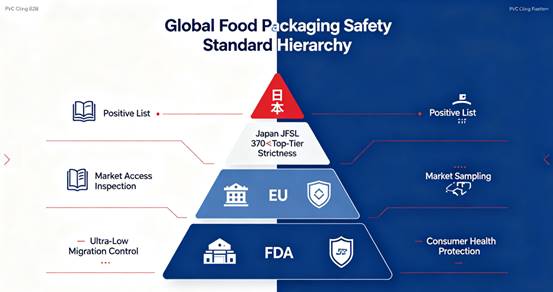
Among all global food safety regulations, Japan’s Food Sanitation Act and JFSL 370 standard are universally recognized as the most rigorous and authoritative system worldwide. While the EU and US also enforce positive list frameworks, Japan’s MHLW system stands out due to its exceptionally low migration thresholds, rigid additive screening, and highly aggressive market sampling mechanisms. Only substances strictly verified and approved by the Japanese Ministry of Health, Labour and Welfare can be used in food-grade materials, with ultra-trace migration limits and full-process market access inspection mechanisms. Products that can enter the Japanese market represent the top safety level of the global food packaging industry.
As a professional foreign trade PVC cling film manufacturer in China, we adopt Japanese raw materials, Japanese production equipment and mature Japanese manufacturing technology. Most importantly, we are among the very few elite Chinese PVC cling film manufacturers fully qualified for official, ongoing export into the high-barrier Japanese market. This article elaborates on why Japanese standards, raw materials and equipment are the gold standard for global food packaging, and why products qualified for the Japanese market are trustworthy for global buyers.
Part 1: Why Japan’s Market Access Is the World’s Most Authoritative Safety Certification
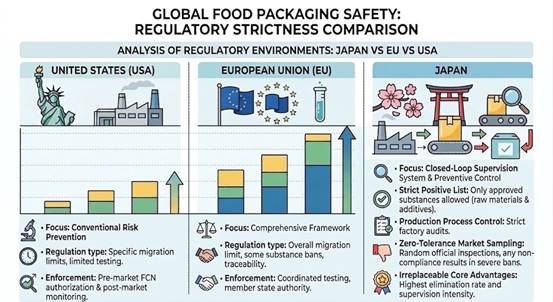
Global food packaging safety standards vary greatly in threshold and execution. The EU and US standards focus on conventional risk prevention, while Japan forms a stricter closed-loop supervision system from raw material admission, production process to terminal market sampling.
Japan’s food contact material supervision features two irreplaceable core advantages: ultra-strict compliance threshold & random official market sampling. All food packaging products sold in Japan must pass random inspections by Japanese official institutions. Any unqualified migration substance, impure raw material or non-standard process will result in permanent market access ban. Its supervision intensity and elimination rate are far higher than those of other global markets.
In the global PVC cling film industry, very few foreign manufacturers can obtain stable Japanese market access qualification. As one of the few qualified suppliers in China, our long-term official export record to Japan is the most intuitive and credible international safety certification. It fully proves that our products have surpassed the industry average safety level and meet the world’s highest food contact safety requirements.
Part 2: Japanese Raw Materials — The Fundamental Guarantee of Cross-Border Safety Compliance
The root cause of unqualified food-grade plastic products lies in impure raw materials and uncontrolled auxiliary ingredients. Ordinary generic raw materials and recycled materials cannot adapt to the ultra-strict positive list requirements of Japan and high-standard international markets.
We utilize high-purity, food-grade S-PVC resins paired with Japanese-standard eco-friendly additives that strictly comply with Japan MHLW Positive List regulations. We strictly select high-purity, food-grade S-PVC resins paired with eco-friendly non-phthalate plasticizers that fully comply with Japan's MHLW Positive List regulations.
The exceptional purity and controlled molecular weight distribution of Japanese S-PVC resins minimize unreacted monomers (VCM < 0.5 ppm). Combined with non-phthalate polymeric plasticizers, our film restricts overall migration well below mandatory global limits, even during prolonged contact with fatty or acidic foods. This core material advantage is the primary premise for our products to stably pass Japanese market access and adapt to global high-standard scenarios.
Part 3: Japanese Equipment & Manufacturing Technology — Standardized Process Creates Consistent High Safety
High-quality raw materials need matched high-standard production technology to realize safety value. The difference in production equipment and technology is the key reason why most factories cannot meet Japanese safety standards even with qualified raw materials.
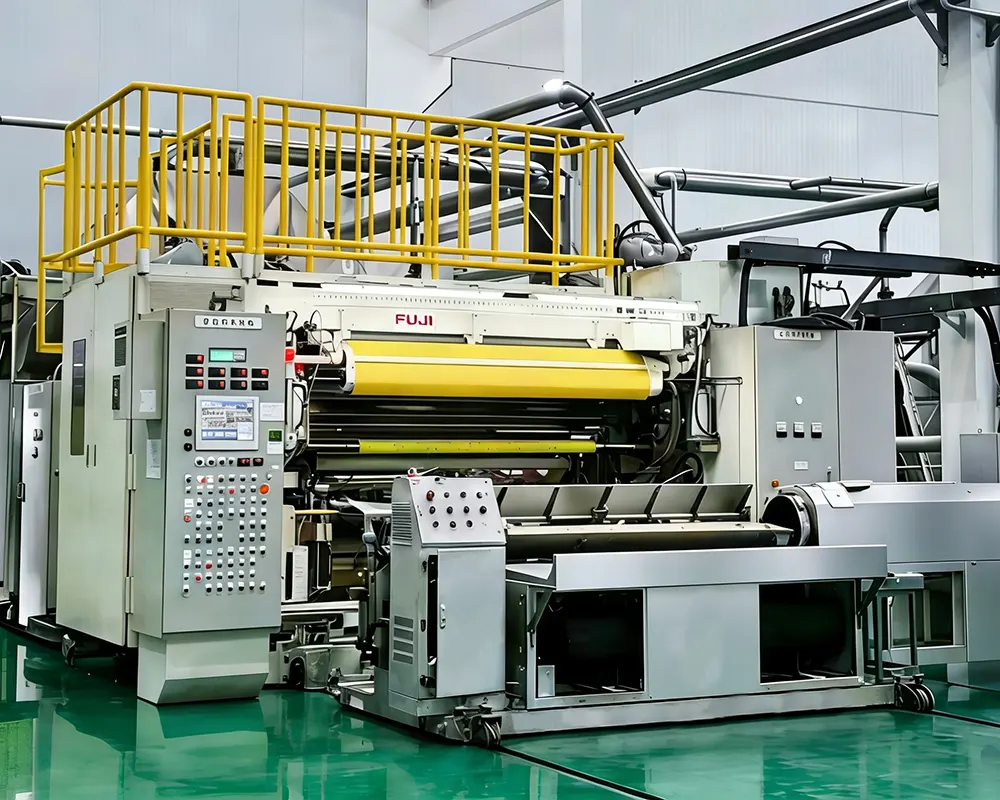
Our factory is fully equipped with original Japanese automated production lines and Japanese standardized manufacturing technology, abandoning traditional low-precision, manually dependent production modes. Our original Japanese multi-layer co-extrusion machinery features Automatic Gauge Control (AGC) to maintain film thickness tolerance within ±1.5%. The low-shear screw profile prevents thermal degradation, ensuring uniform physical strength and eliminating batch-to-batch safety variations.
We strictly follow Japanese factory management and purification standards to build a dust-free constant-temperature production workshop, implement full-process quality control in accordance with Japanese manufacturing specifications, and maintain consistent production standards matching local Japanese factories. This standardized production system is the core support for our long-term stable export to Japan and global high-end markets.
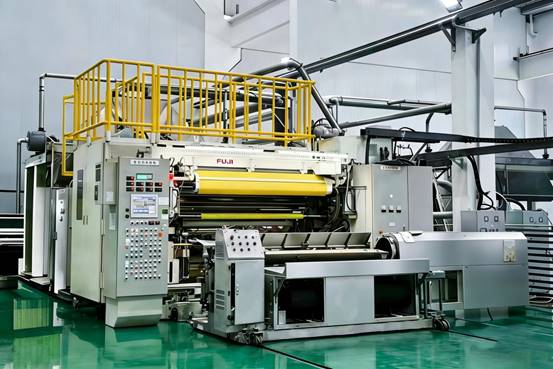
Japanese Machine
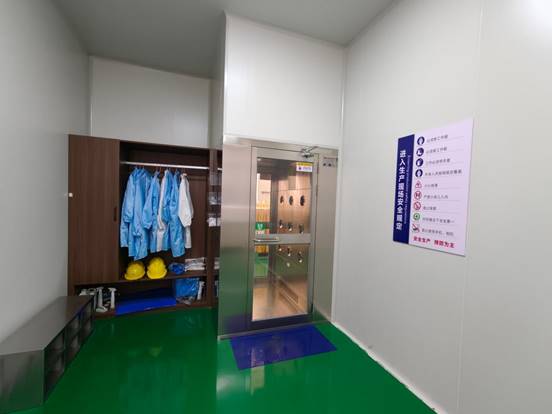
ISO Class 8 Cleanroom Packaging Workshop
Part 4: Core Value of Japanese Standard Manufacturing & Japanese Market Qualification
For global bulk buyers and brand customers, product safety stability and market compliance are the top priorities of supply chain selection. Our dual advantages of Japanese raw material & equipment system + exclusive Japanese market access qualification bring irreplaceable core value to global partners.
4.1 Global Top-Level Compliance & Zero Market Access Barriers
Adhering to Japan’s rigorous food safety framework provides a supreme quality benchmark, greatly streamlining compliance verification under EU (10/2011) and US FDA regulations. The Japanese market access qualification is a global universal high-standard safety passport, helping customers smoothly access all high-end global markets without repeated testing and certification costs.
4.2 Authoritative Market Verification & Zero Safety Risk
Different from laboratory data and theoretical certification, our long-term stable official export performance to Japan is real market verification under the strictest supervision. It proves that our products have no hidden safety risks in long-term commercial use, effectively avoiding brand safety incidents and after-sales risks for customers.
4.3 Stable & Consistent Premium Product Performance
Supported by pure Japanese raw materials and standardized Japanese precision technology, our products maintain stable toughness, adhesion, aging resistance and temperature resistance in all usage scenarios. While ensuring absolute safety, the product’s fresh-keeping performance and service life are far superior to ordinary low-standard products, creating stable long-term value for end consumers and buyers.
Conclusion: Japanese Standard Qualification Is the Best Proof of Premium Safety
In the global food packaging industry, laboratory data can be polished, but long-term access to the world’s most stringent Japanese market cannot be achieved by speculation. As a premier Chinese PVC cling film manufacturer maintaining stable export access to Japan, our strength is witnessed by the most authoritative international market.
We always adhere to Japanese imported raw materials, Japanese automated equipment, and Japanese standardized manufacturing technology, take Japanese ultra-high safety standards as the production bottom line, and rely on real international market access performance to provide global customers with verifiable, trustworthy, and high-standard food packaging solutions.
In the future, we will continue to maintain Japanese standard production specifications, consolidate international high-end market advantages, and continuously deliver safe and reliable packaging products for global food supply chains.
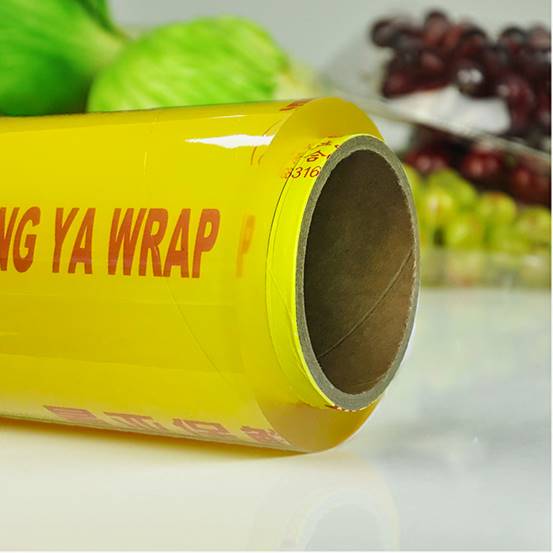
Reference Basis
1. Japan MHLW Official Release: JFSL 370 Food Sanitation Positive List System & Market Access Supervision Rules
2. Global Food Packaging Safety Standard Comparative System (EU 10/2011 / US FDA 21 CFR / Japan JFSL370)