PVC vs PE vs PVDC Cling Film: How to Choose the Right Food-Grade Wrap (2026 Buyer’s Guide)
Every year, roughly one third of the food produced for human consumption is lost or wasted — about 1.3 billion tonnes, according to the UN Food and Agriculture Organization (FAO). For fresh produce, the loss rate can reach 40–50%. For supermarkets, fresh-food e-commerce, catering and food processors, a lot of “unsold” food is not a sales problem — it is a packaging problem: fogged film, poor cling, weak barrier, shorter shelf life. Cling film is the first line of defense against fresh-food loss.
But PVC, PE and PVDC films all claim to be “food grade”. How do you actually choose? This guide walks you through the regulatory frameworks of China, the US and the EU.
1. Three myths about cling film
Myth 1: PVC cling film is toxic. Reality: compliant food-grade PVC is safe. The US FDA allows polyvinyl chloride for food contact under 21 CFR 177.1950; the EU sets migration limits under Regulation (EU) No 10/2011; China manages it under GB 4806.7. In fact, PVC cling film — with its excellent anti-fog, tight conformity and high clarity — remains one of the mainstream materials for fresh-produce packaging worldwide, with safety and fresh-keeping performance proven over decades under compliant formulations and normal chilled use. “Toxic” claims usually trace back to non-food-grade raw materials, non-compliant plasticizers, or misuse (e.g., using a film not rated for heating in frying or prolonged high heat). Judge by test reports, not by the material name.
Myth 2: Thicker film keeps food fresher. Reality: freshness depends on formulation (anti-fog agents, plasticizer system, barrier design) and how tightly the film conforms. Commercial PVC films are typically 8–12 µm; PE films are typically 10–20 µm. Thicker is not better.
Myth 3: The stickier, the better. Reality: cling comes from surface formulation; it has no direct relationship with food-contact safety or barrier performance. Excessively tacky film can leave adhesive residue and slow down packaging lines.
2. PVC vs PE vs PVDC: core performance
Table 1: Core properties (industry-level comparison; actual performance varies by formulation)
| Property | PVC | PE | PVDC |
| Transparency | High | High | High |
| Cling / conformity | High | Medium | Medium-high |
| Anti-fog | Excellent at low & high temp | Fair, fogging common | Good |
| Oxygen/moisture barrier | Moderate | Low-moderate | Highest |
| Heat tolerance | ~130°C; short heating OK (varies by formulation; check product label) | ~110°C; short microwave OK | ~140°C; microwave/steam OK |
Table 2: Cost and applications
| Material | Plasticizer | Relative cost | Recycling | Typical uses |
| PVC | Food-grade plasticizers required; can be free of 18P (18 common phthalates) | Medium | Harder | Supermarket produce, cut fruit, chilled-cabinet trays; household refrigerated fresh-keeping |
| PE | Usually none | Low | Easier | Bakery light packing; specific heat/microwave needs |
| PVDC | Usually none | High | Harder | Meat, long-shelf-life, high-barrier packing |
Note: these are industry-level comparisons; verify actual performance with samples and test reports before purchase.
|
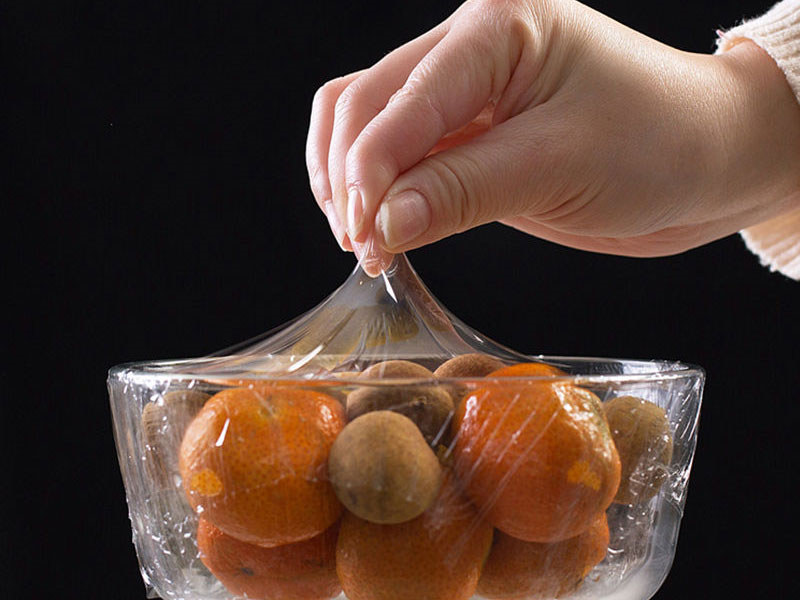
Why fresh-food businesses and households prefer PVC cling film ① Outstanding anti-fog: no condensation in chilled cabinets — products look their best; ② Tight conformity: clings firmly to trays without slipping, locks in moisture; ③ High clarity: highlights food gloss for better shelf appeal; ④ Good stiffness and puncture resistance: fewer broken packs in packing and transit; ⑤ Moderate cost with OEM customization — excellent value; ⑥ Heat-resistant to ~130°C, safe for short reheating. It works just as well at home: cover fruit, leftovers and cut produce with food-grade PVC film for tighter, fog-free fresh-keeping. |
3. What “food grade” really means: 4 standards + 1 report
China (national standards)
- GB 4806.7 Food Contact Plastic Materials and Articles — general safety requirements (2023 edition in force since September 2024, replacing the 2016 edition)
- GB 9685 Standards for the Use of Additives in Food Contact Materials and Articles — permitted additives and their limits (e.g., DEHP migration limit 1.5 mg/kg)
- GB 31604 series — test methods (e.g., GB 31604.30, phthalates content and migration; the industry “18P” refers to 18 phthalates)
- GB/T 10457 Quality Requirements for Food Plastic Self-Adhesive Cling Film — product quality standard
United States (FDA): 21 CFR 177.1950 (polyvinyl chloride for food contact) and 21 CFR 178.3740 (plasticizers). A common requirement: vinyl chloride monomer (VCM) residue ≤ 1 ppm.
European Union: Regulation (EU) No 10/2011 sets specific migration limits (SML, in mg/kg), including group limits for phthalates (e.g., DBP/BBP/DEHP SML(T) 60 mg/kg; DINP/DIDP 9 mg/kg).
Ask your supplier for 5 things — do not just trust the words “food grade”:
|
4. Choose by application
| Application | Recommended | Why |
| Supermarket produce / cut fruit / chilled cabinets | PVC | Anti-fog, tight conformity, high clarity, moderate cost |
| Meat and long-shelf-life items | PVDC or high-barrier laminate | Strongest oxygen/moisture barrier, longer shelf life |
| Bakery and light deli packing | PE or PVC | Depends on cost, sealing method and display needs |
| Household daily use | PVC (food grade) | Tight cling, anti-fog, better fresh-keeping; heat-resistant to ~130°C for short reheating |
| Automatic packing lines | Match equipment specs | Roll diameter, width and friction coefficient drive efficiency |
5. 8-point sourcing checklist
- Match material to application (produce first: anti-fog)
- Test report covers national limit items (incl. 18P migration)
- Export-market compliance (FDA / EU) checked item by item
- Check weight and length: spot-check grammage, meters, thickness uniformity
- Customization: OEM printing, sizes, cutters, packaging boxes
- Delivery: stock availability, MOQ, lead time
- After-sales and batch traceability
- Test samples first — buy on data, not promises
6. Japanese technology: why it matters for cling film quality
Cling film looks simple, but it is a system engineering of formulation, process and quality control: thickness uniformity, dispersion of anti-fog masterbatch, stable web tension, clean-room discipline — every link determines cling, clarity and shelf-life performance. Japan is one of the most mature regions for cling-film manufacturing, with decades of expertise in extrusion, formulation precision and production management. That is why “Japanese process” is so trusted in food packaging.
For buyers, a “Japanese technology background” usually means three things: mature formulations (fewer trial-and-error costs), stable batches (less quality fluctuation), and rigorous process discipline (professional delivery and issue response). That is why more fresh-food companies now include “technical pedigree” in their supplier evaluation.
7. About Youquan Food Packaging (Jiangsu) Co., Ltd.
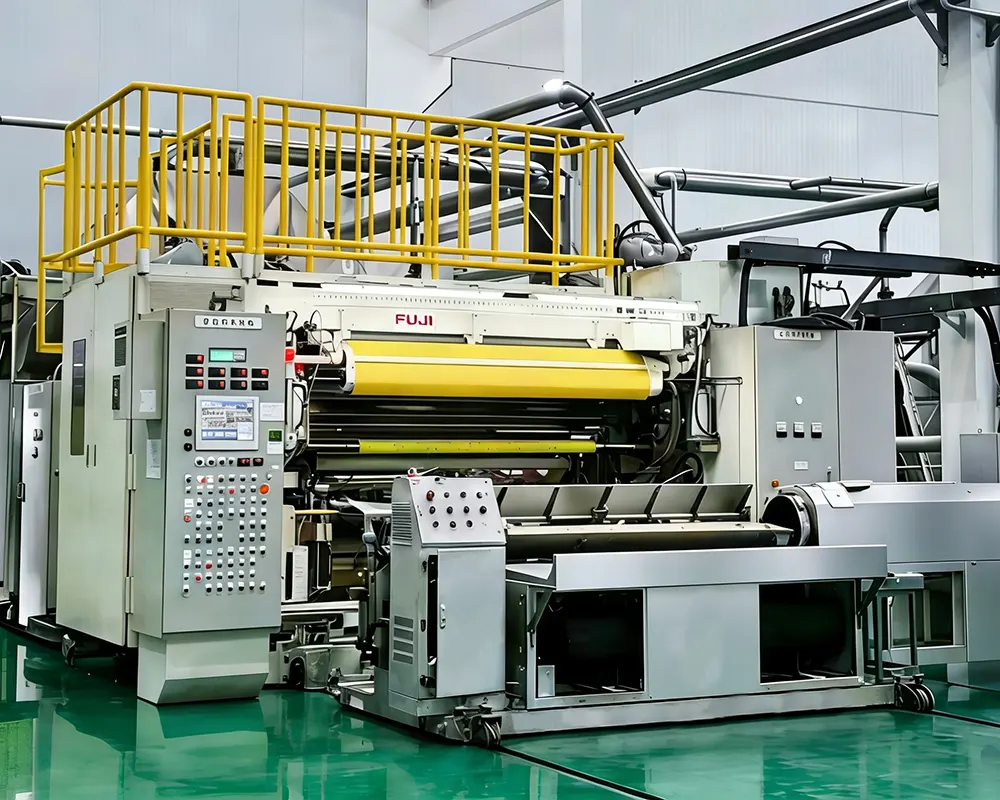
If you are sourcing reliable cling film for fresh food, meet Youquan: a joint venture between Easeca Trading Company Limited (Hong Kong) and a team of experts in Japanese plastic-film technology, equipped with imported production lines (e.g., FUJI). We focus on food-grade PVC cling film, tested to GB 4806.7, GB 9685 and GB 31604 series standards — free of 18 common phthalates (“18P”), with excellent anti-fog, clarity, strength and conformity. OEM customization (brand printing, sizes, cutters, packaging) is available, with full-meter/full-weight commitment and free samples.
Request a free sample or quote:
|
Sources: FAO global food loss and waste data; US eCFR 21 CFR 177.1950 / 178.3740; EUR-Lex Regulation (EU) No 10/2011; China GB 4806.7 (issued by the National Health Commission), GB 9685, GB 31604 series and GB/T 10457-2021. Information current as of September 2026; for compliance decisions, always refer to the latest official texts and third-party test reports.