The Global Food Packaging Reset: Compliance, Cost, and the Case for Agile Manufacturing (2024–2026)
How raw-material volatility, regional compliance gates, and geopolitical trade dynamics are reshaping flexible food packaging procurement — and the new baseline for strategic suppliers.
——————————————————————————————
0. Introduction: A Market Under Triple Pressure
The global food packaging industry is navigating one of the most complex periods in recent memory. Over the past two years, volatile raw-material prices, shifting regional regulatory frameworks, and intensifying geopolitical trade friction have fundamentally changed how procurement teams evaluate their supplier networks.
Three forces deserve particular attention in 2024–2026. First, the regulatory landscape has been rewritten: the EU’s Packaging and Packaging Waste Regulation ((EU) 2025/40, “PPWR”) was published in January 2025 and became fully enforceable across all 27 member states on 12 August 2026, replacing the nearly 30-year-old 94/62/EC Directive. Meanwhile, Japan fully enforced its Positive List system for food-contact synthetic resins on 1 June 2025 — a fundamentally stricter regulatory gate for PVC-based products.
Second, raw-material prices have been far from stable. PVC resin prices rebounded roughly 7% in the first two months of 2026 as feedstock and supply constraints tightened, with domestic spot prices reaching about RMB 4,550–4,600/ton by early March 2026, and Asian producers raising September offers by US$10–30/ton. Plasticizers such as DOP — the functional core of flexible PVC film — have swung through double-digit percentage ranges over the past year, rising about 2.8% in August 2026 alone.
Third, trade policy has become a live variable. In July 2026, the United States imposed a further 12.5% Section 301 tariff on Chinese-origin goods as part of a measure covering 60 economies, stacking on top of earlier tariffs and most-favored-nation rates. For packaging buyers in North America, this has forced a continuous recalculation of landed cost.
For commercial distributors, supermarket chains, and food processors, choosing the right packaging partner now means balancing three things at once: functional performance, strict market access, and total landed cost.
1.Strategic Market Access: Compliance Is a Map, Not a One-Size-Fits-All Stamp
Regulatory compliance remains the single biggest hurdle in international trade. But the critical insight of the past two years is that compliance is no longer a single, universal standard — it is a regional map. The most successful sourcing strategies do not chase every certification on earth; they align precisely with the markets they actually serve.
In Europe, the conversation has shifted decisively toward circular packaging and stricter scrutiny of specific additives. PPWR is not a simple update — it is a regime change that governs packaging from design to end-of-life, covering recyclability, recycled content, and extended producer responsibility, and it applies directly in all member states without national transposition. For any exporter targeting the EU, compliance now begins at the design table, not at the port.
Japan represents a different but equally demanding reality. Following the 2020 amendment of the Food Sanitation Act, Japan introduced a Positive List system for food-contact synthetic resins and enforced it fully from 1 June 2025. Under this regime, every resin, additive, and monomer used in food-contact products must appear on an official list; substances not listed require full toxicological evaluation. For PVC cling film specifically, Japanese food-hygiene monitoring in 2024 reportedly flagged non-compliance rates of up to 23% among imported PVC food-contact products, with plasticizer and heavy-metal migration as the leading issues. This is exactly why suppliers entering Japan must be built on verified resin, disciplined formulation, and rigorous migration control — not on paper certificates alone.
Across North America, Latin America, and key emerging markets, FDA clearance continues to serve as the gold standard for food-grade safety. Under the FDA’s 21 CFR framework, both the substances used and their migration behavior are regulated, and FDA compliance is widely recognized and accepted by distributors, supermarkets, and processors as the reference for market entry.
The practical takeaway: rather than attempting a one-size-fits-all approach globally, successful sourcing focuses on deep alignment with regional standards — ensuring that every roll delivered meets local regulatory thresholds without passing unnecessary compliance overhead onto the buyer. The right question is not “How many certificates does the supplier hold?” but “Does the supplier’s certification actually open the doors I need?”
2. The Japanese Engineering Benchmark: Resin, Machinery, and Precision
In the PVC cling film sector, Japanese technical standards are widely recognized as the benchmark for clarity, stretch ratio, memory retention, and anti-fog performance. Achieving these metrics depends on three core pillars — and it is precisely these pillars that determine whether a product can credibly serve the Japanese market under the new Positive List regime.
• Upstream raw-material selection: using specialized premium resins ensures superior molecular-chain stability, directly improving puncture resistance, optical clarity, and — critically — migration performance that satisfies Japan’s strictest requirements.
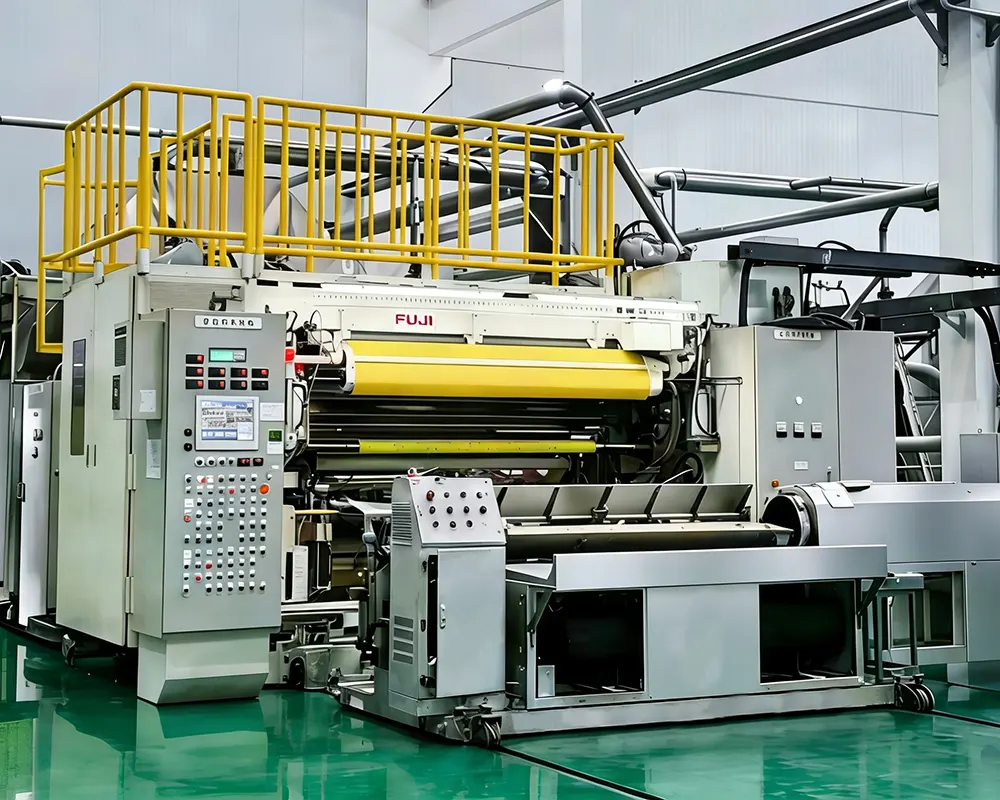
• Precision extrusion machinery: processing film through Japanese-designed extrusion equipment guarantees tight gauge control, minimizing thickness variance across wide-web rolls — the difference between a roll that runs cleanly on a high-speed line and one that jams or tears.
• Formulation and process engineering: proven Japanese manufacturing techniques optimize the plasticizer-to-resin matrix, ensuring consistent cling force and stable anti-fog performance under both high-speed mechanical wrapping and manual application.
Our manufacturing philosophy is rooted in this high-precision tradition. Guided by engineering expertise cultivated through over a decade of technical experience in leading Japanese film enterprises, we align our formulation discipline, quality assurance, and equipment calibration with these uncompromising standards.
3. The Cost Reality: Raw Materials, Tariffs, and Landed Cost (2024–2026)
No sourcing conversation in 2024–2026 is complete without addressing cost. Three forces have dominated the picture.
• Raw-material volatility: PVC resin rebounded about 7% in early 2026 (to roughly RMB 4,550–4,600/ton by early March), while DOP plasticizer prices rose about 2.8% in August 2026 alone after a year of double-digit swings. Cost stability is now a supplier capability, not an assumption.
• Tariff and trade friction: the July 2026 US Section 301 measure added 12.5% on Chinese-origin goods, on top of earlier duties. Landed cost is now a moving target that must be continuously recalculated, and the ability to respond quickly has become a genuine competitive differentiator.
• The landed-cost mindset: when materials swing by double digits and duties shift, the lowest FOB price is rarely the cheapest outcome. What matters is total landed cost — unit price, freight, duties, rejection rates, and the cost of a compliance failure at customs.
This is where a transparent, flexible, quality-disciplined partner creates real, measurable value — one that stabilizes supply, holds quality across batches, and keeps landed cost predictable.
4. Conclusion: A Five-Question Checklist for Sourcing Teams
As the global packaging sector completes this fundamental reset, we recommend that procurement and regulatory teams evaluate potential film suppliers against five strategic criteria:
•Material Traceability & Compliance Mapping: Can the supplier verify that every resin grade, plasticizer, and additive complies with market-specific gates (such as EU PPWR, Japan’s Positive List, or FDA 21 CFR)?
•Technical & Equipment Heritage: What specific machinery standards, gauge-control technologies, and formulation expertise back their performance claims?
•Machine Packaging Compatibility: Has the film been tested and certified for seamless performance on high-speed automatic wrapping and labeling equipment (e.g., DIGI systems)?
•Supply Chain Agility: Is the production model engineered exclusively for rigid, high-volume single SKUs, or can it accommodate flexible, customized specifications and mixed-container orders?
•Landed-Cost Risk Management: How transparently does the supplier help manage raw-material price swings, ocean freight risk (Incoterms selection), and sudden tariff adjustments?
The answers separate a transactional supplier from a strategic partner. In a market defined by compliance complexity, cost pressure, and precision demands, the suppliers that thrive will be those that match capability to market — honestly, flexibly, and precisely.
——————————————————————————————
References
• Regulation (EU) 2025/40 (PPWR) — published 22 Jan 2025, in force 11 Feb 2025, fully applicable 12 Aug 2026; replaces Directive 94/62/EC.
• Japan Positive List system for food-contact synthetic resins — full enforcement from 1 June 2025 under the Food Sanitation Act; JFSL No. 370.
• FDA food-contact framework under 21 CFR (e.g., 21 CFR 177 for indirect food additives).
• US Section 301 tariff measures, July 2026 (additional 12.5% on Chinese-origin goods; measure covering 60 economies).
• PVC resin and DOP plasticizer market data, 2025–2026 (PVC spot ~RMB 4,550–4,600/ton by early March 2026; DOP +2.8% in Aug 2026).