Why Tensile Strength Matters in PVC Cling Film
What Buyers Should Know About Tensile Strength, Elongation and Real-World Packaging Performance
When purchasing PVC cling film, buyers often compare thickness, roll length, transparency and price first.
But there is another performance characteristic that can have a major impact on the actual packaging experience: tensile strength.
A cling film may look perfectly transparent and meet the specified thickness, yet still perform poorly if it tears easily during stretching, wrapping or machine application.
For supermarkets, food processors, restaurants and packaging distributors, this can lead to more film breakage, higher material consumption, slower packaging operations and inconsistent packaging quality.
That is why tensile strength should not be treated as just another laboratory number. It is an important indicator of how a PVC cling film behaves when it is actually being used.
1. What Is Tensile Strength in PVC Cling Film?
Tensile strength describes the ability of a material to withstand pulling force before it fails.
For a thin plastic film, tensile properties can be evaluated using standardized testing methods. ASTM D882, for example, covers tensile testing of plastic films and thin sheeting. The current ASTM D882-26 standard notes that test results can be affected by factors including specimen thickness, specimen preparation, testing speed, grips and measurement conditions.
For PVC cling film, tensile performance is closely related to another important parameter:
Elongation at Break
Elongation at break describes how far a film can stretch before breaking, normally expressed as a percentage of its original length.
These two properties should be considered together.
A film with good tensile strength but insufficient elongation may resist force but still feel difficult to stretch.
A film with high elongation but insufficient strength may stretch easily but tear when excessive force is applied.
For practical food packaging, the goal is not simply to maximize one number.
The goal is to achieve a balanced combination of strength, stretchability, cling, transparency and stability.
2. Why Does Tensile Strength Matter in Everyday Food Packaging?
Imagine wrapping a tray of fresh meat in a supermarket.
The operator pulls the film across the tray, stretches it around the edges and applies enough tension to create a tight package.
During this process, the film experiences continuous mechanical stress.
If the film has insufficient tensile performance, several problems may occur:
- The film may break during stretching.
- Small tears may develop around corners.
- The film may become difficult to handle.
- More film may be consumed because operators need additional layers.
- Machine packaging lines may experience film breakage.
- Packaging consistency may be reduced.
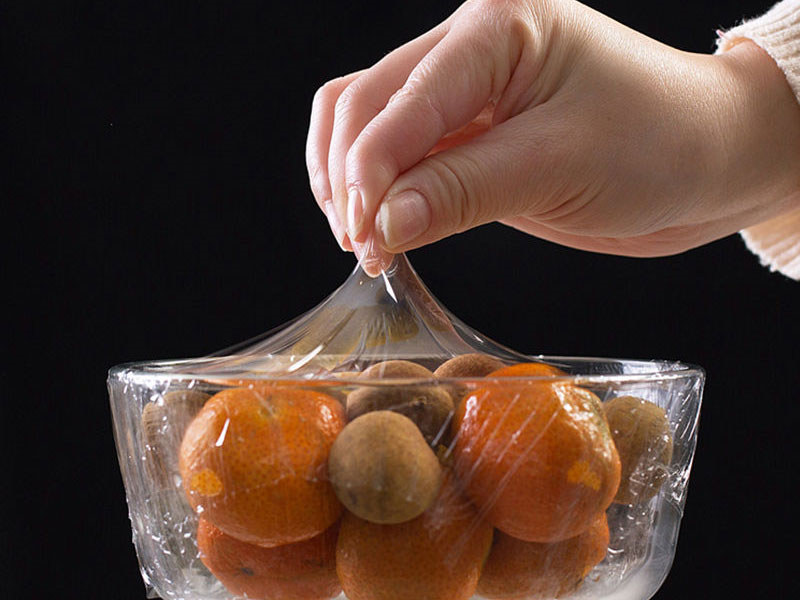
By contrast, a well-balanced PVC cling film can stretch smoothly while maintaining sufficient integrity during wrapping.
This is particularly important for fresh food packaging, where the film needs to conform closely to irregular shapes without compromising the package.
3. Why Nominal Thickness Can Be Misleading for Packaging Efficiency
One common mistake when comparing cling films is to assume:
Thicker film = stronger film.
Thickness certainly matters, but it is not the only factor determining performance.
Two films with similar nominal thickness can behave differently because of differences in:
- Raw material quality
- Formulation
- Plasticizer system
- Processing conditions
- Molecular structure
- Thickness uniformity
- Production equipment
- Cooling and forming conditions
- Quality-control procedures
This is why professional buyers should evaluate film performance rather than comparing thickness alone.
For example, a 10-micron film with consistent thickness and well-controlled physical properties may perform very differently from another nominally 10-micron film with inconsistent thickness or weaker mechanical properties.
At YouQuan, accurate thickness and physical strength are treated as interconnected quality parameters rather than isolated specifications. Our product range includes PVC cling films in different thickness and length configurations for household, supermarket and machine-use applications.
4. Tensile Strength and Elongation: The Balance Matters
For cling film, excellent performance is usually about balance.
Tensile Strength
Higher tensile strength can help the film withstand pulling forces during wrapping and handling.
Elongation
Good elongation allows the film to stretch around food containers and products without breaking prematurely.
Cling
Cling performance helps the film adhere to itself and the packaged surface, helping maintain the integrity of the package.
Thickness Uniformity
Consistent thickness helps provide more predictable mechanical performance across the roll.
Tear Resistance
The film should resist the development and propagation of tears during handling.
These characteristics interact with each other.
That is why evaluating a cling film based on a single specification can provide an incomplete picture of its actual performance.
5. Why Tensile Performance Matters for Machine Packaging
The importance of tensile performance becomes even clearer in automated packaging.
On a manual packaging line, an operator can sometimes compensate for a weak film by adjusting the wrapping technique.
A machine cannot do this in the same way.
Automatic packaging equipment applies film at a controlled speed and tension. If the film cannot withstand the mechanical stress generated during the process, film breakage can interrupt production.
For high-volume food processors and supermarket operations, even small improvements in packaging stability can have an operational impact.
This is why machine-use cling film often requires a different specification from household-use film.
At YouQuan, we provide different PVC cling film specifications for applications ranging from shorter household rolls to longer machine-use rolls, with available specifications varying according to application requirements.
6. How Should Buyers Evaluate Tensile Performance?
A professional purchasing evaluation should go beyond asking:
“What is the thickness?”
Instead, buyers can ask suppliers for information covering several key parameters.
1. Thickness
Is the actual thickness consistent throughout the film?
2. Tensile Strength
How much tensile force can the film withstand before failure?
3. Elongation at Break
How far can the film stretch before breaking?
4. Cling Performance
Does the film maintain reliable adhesion during actual packaging?
5. Tear Resistance
How does the film behave when a small cut or puncture occurs?
6. Transparency
Does the film maintain clear product visibility?
7. Anti-Fogging Performance
Does condensation significantly reduce product visibility under refrigerated conditions?
8. Application Performance
Does the film perform consistently on the customer’s actual packaging equipment and food products?
This last question is particularly important.
Laboratory data is useful for specification and quality control, but actual application conditions should also be considered when selecting packaging film.
7. How Production Technology Influences Film Strength
Tensile performance does not begin in the laboratory.
It begins during production.
The quality and consistency of raw materials, formulation, processing conditions and equipment can all influence the physical properties of the finished film.
This is one reason why manufacturing consistency matters when purchasing PVC cling film at commercial scale.
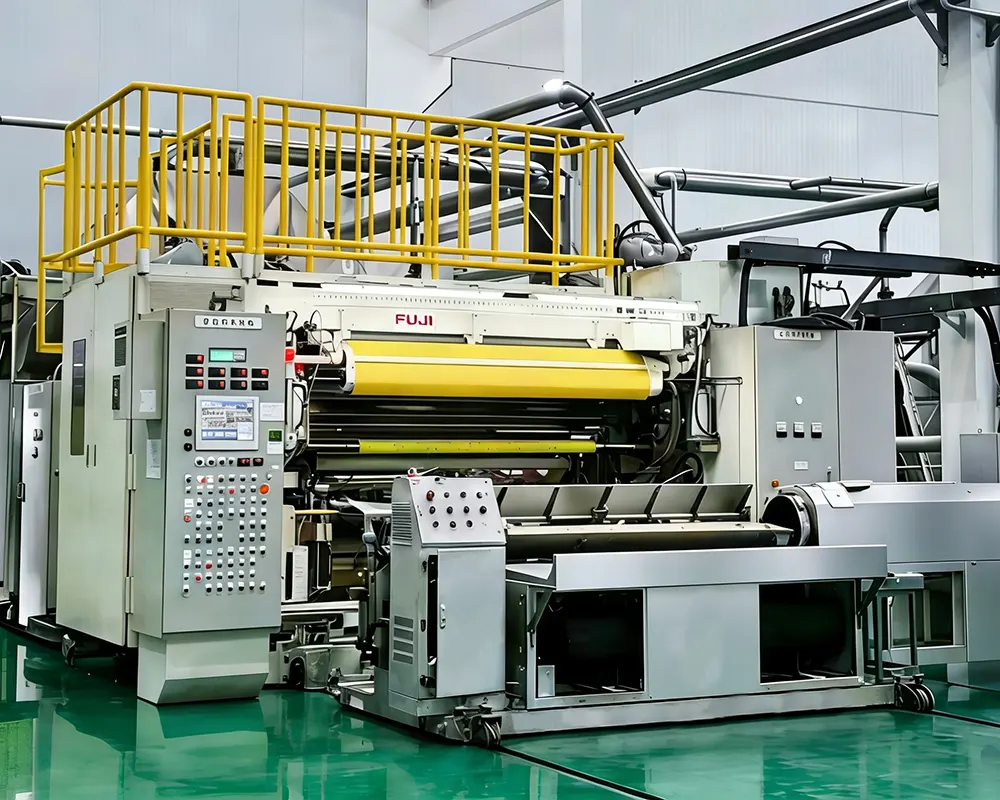
YouQuan Food Packaging was established with a focus on Japanese plastic-wrap technology and uses advanced production equipment and manufacturing technology managed by Japanese technical expertise. The company’s stated production advantages include Japanese equipment, imported raw materials, customized production and quality-control systems.
Our objective is not simply to manufacture a film that meets a nominal thickness specification.
The objective is to produce film with consistent and predictable performance from roll to roll.
8. From Raw Materials to Finished Film: Quality Starts at the Beginning
For a high-performance cling film, quality control should cover the entire production process.
A typical quality-control approach includes:
Raw Material Selection
↓
Formulation Control
↓
Production Process Control
↓
Thickness Uniformity
↓
Physical Performance Testing
↓
Finished Roll Inspection
↓
Packaging and Shipment
This process is particularly important for export customers, because a film that performs well in a sample trial but changes significantly between batches can create problems for distributors and end users.
Consistency is therefore just as important as peak performance.
9. Why Japanese Manufacturing Technology Matters at YouQuan
YouQuan has built its manufacturing system around Japanese plastic-wrap production expertise.
The factory’s website identifies Japanese equipment, imported raw materials and Japanese technical expertise among its core manufacturing advantages. The company also states that its production system emphasizes standardized manufacturing and quality control.
For a thin packaging film, manufacturing precision matters because small variations can affect the final product’s physical behavior.
Our approach is therefore based on controlling the manufacturing process rather than relying only on final-product inspection.
This philosophy is particularly important when supplying customers who require:
- Stable film performance
- Consistent thickness
- Reliable stretching
- Strong mechanical properties
- Customized specifications
- Long-term supply stability
10. Tensile Strength Is Also Connected to Food Protection
Tensile strength does not directly “preserve food” by itself.
However, mechanical integrity helps the packaging perform its intended function.
A properly applied cling film can help create a continuous covering around food, reducing unnecessary exposure of the packaged surface to the surrounding environment.
For fresh produce, packaging performance can also interact with moisture loss, respiration and other factors affecting quality during storage and distribution.
YouQuan’s R&D team has conducted comparative food-preservation testing examining parameters such as weight loss, respiration and vitamin C retention in fresh produce. Such testing illustrates why packaging performance should ultimately be evaluated in the context of the food application rather than by a single film specification alone.
11. What Should a Professional PVC Cling Film Supplier Be Able to Explain?
When evaluating suppliers, buyers can ask five simple questions:
Question 1
What are your tensile strength and elongation specifications?
Question 2
How do you control thickness consistency?
Question 3
What testing methods do you use?
Question 4
Can you provide samples for application testing?
Question 5
Can you maintain consistent performance across repeated production batches?
A supplier that can clearly answer these questions demonstrates a different level of technical understanding from a supplier that only quotes price, thickness and roll length.
12. What Makes a High-Performance PVC Cling Film?
There is no single number that defines a “good” cling film.
A high-performance product should provide a suitable balance of:
Strength
Stretchability
Cling
Transparency
Thickness consistency
Tear resistance
Anti-fogging performance
Processing stability
Food-contact compliance
And most importantly:
Consistent performance in the customer’s actual application.
That is the standard that matters to food processors, supermarkets, distributors and packaging brands.
13. The YouQuan Approach: Performance Starts With Manufacturing
At YouQuan Food Packaging, we believe that the performance of PVC cling film is determined long before the finished roll reaches the customer.
It begins with material selection.
It continues through formulation and production.
It is verified through quality control and testing.
And it is ultimately measured by how the film performs in real packaging applications.
Our focus on Japanese production technology, advanced equipment, imported raw materials and customized manufacturing allows us to develop PVC cling film for different packaging requirements, from household and supermarket applications to longer machine-use rolls.
For buyers looking for a long-term PVC cling film manufacturing partner, the question should therefore not simply be:
“How many microns is the film?”
A better question is:
“How consistently does the film perform when we actually use it?”
That is where tensile strength, elongation, thickness consistency and manufacturing quality become important.
Conclusion
Tensile strength is one of the key mechanical properties that can influence the real-world performance of PVC cling film.
However, it should never be considered in isolation.
The most reliable evaluation combines tensile strength, elongation, thickness uniformity, cling performance, tear resistance, transparency and application testing.
For professional food packaging buyers, understanding these parameters can help reduce film breakage, improve packaging efficiency and select a supplier based on measurable performance rather than price alone.
At YouQuan Food Packaging, we continue to focus on manufacturing consistency, Japanese production technology and performance-oriented PVC cling film solutions for global food packaging customers.
Because a good cling film should not only stretch.
It should stretch when you need it to—and stay strong when it matters.